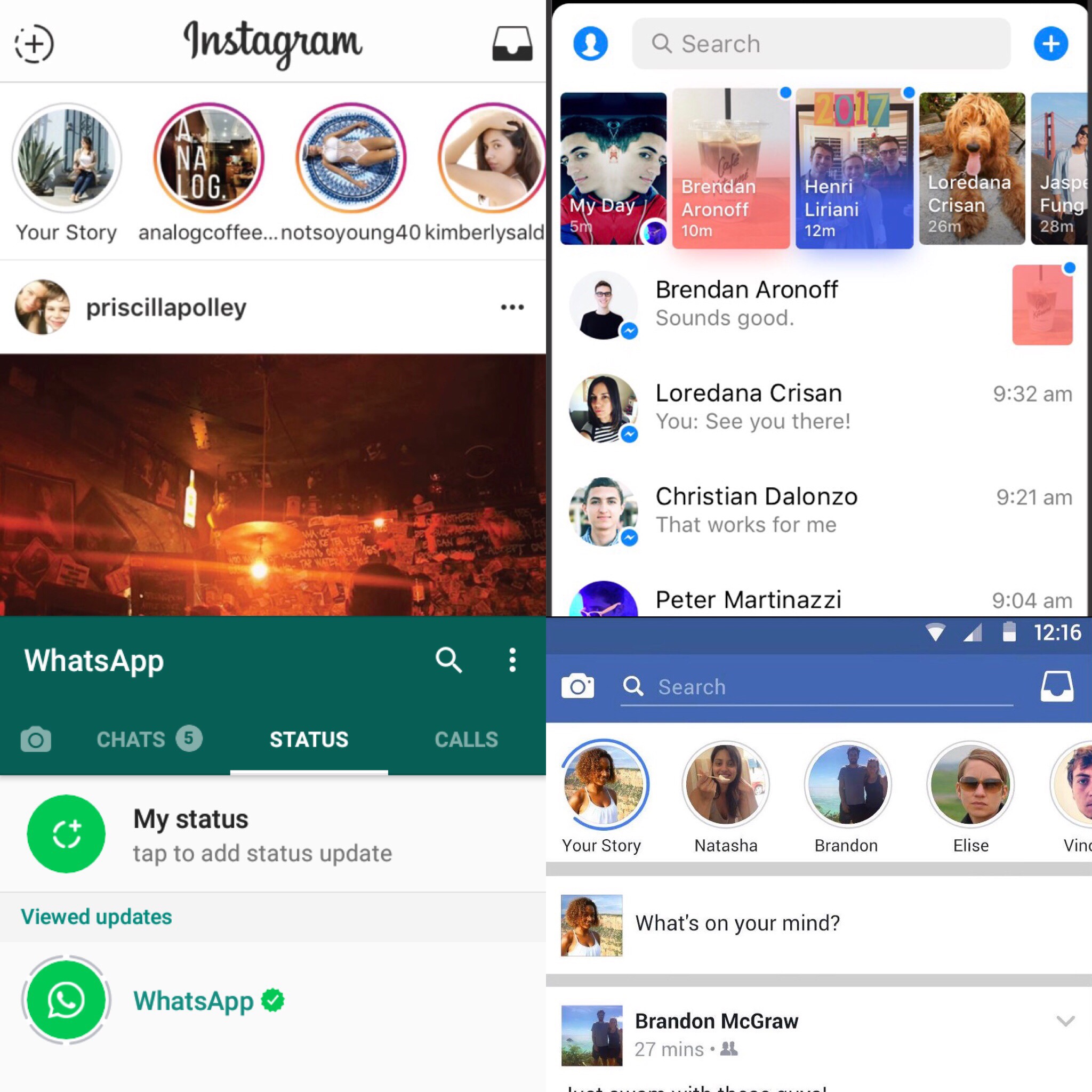
Facebook created a mess trying to take on Snapchat

If you use Facebook, Instagram, Messenger or WhatsApp, you have probably noticed recent updates that allow you to share a picture that expires after 24 hours.

Stories, Shared Days, or Status, all different names for the same feature across 4 different apps. This is what they look like side by side:

Facebook is trying to suffocate Snap by flooding every app they own with the one thing that made Snapchat special.

Continue reading “Facebook created a mess trying to take on Snapchat”

How iMessage joined the ‘fun messaging apps’ club

Waiting for my delayed flight to take off, I came across Phoneys, an iMessage sticker pack with some controversy.

Phoneys allows users to cover friends’ messages with stickers that look like a real message. In less than a week, it became the #1 Top Paid and #1 Top Grossing iMessage app. Here’s how it works:


Of course, Apple noticed and asked Adam, the developer, to update it so that users don’t get confused or think that their iPhone has been hacked, otherwise the app would be taken down.

With iMessage on iOS 10, Apple tried to create a fun experience that can compete with Snapchat, the king of fun messaging.

A very clever way of doing this was… well, letting others actually do it and lure them into a new iMessage app store (following Facebook’s steps with Messenger).

I find fascinating how Apple simplified and streamlined the creation of stickers for iMessage. Anyone can create a fun experience (and sometimes a cash machine) with a good idea and a few nights of work.

Fun messaging apps are the next gold mine: emojis, stickers, GIFs… the best way of increasing the variety and quality of options is to let 3rd party developers do it. How long will it take for Snapchat to open its own app store?

Adam is now debating what to do with his “stupid little sticker pack”, as he calls it. To him, I’d say: enjoy the viral ride and start thinking of the next great idea, you sure know how to monetize it.

You can read his full story in Medium.

Image via Adam Howell

How to swap your iPhone 6s for the new iPhone 7 using the iPhone Upgrade Program

If you used the new iPhone Upgrade Program to get your iPhone 6s, you will probably be wondering how to swap it for the new iPhone 7 when it comes out next month.

Since this is the very first year that the Upgrade Program has been active, I was wondering the same thing, so I went online to get some answers from the always helpful Apple Store Specialists.

Here is the full transcript:

Tuesday, Aug 30, 2016 06:48 PM
Duration: 9 minutes 51 seconds

Apple:
Welcome to Apple.
What can we do for you today?
Ivan:
Hi, I wanted to know how will the iPhone Upgrade Program work when a new iPhone is released. How will I be able to exchange my iPhone for a new one?
Apple:
Please wait while I connect you with an Apple Specialist.
Kaitlyn:
Welcome to the Apple Online Store! My name is Kaitlyn! I can absolutely help with your iPhone Upgrade Program questions.
Are you currently on the iPhone Upgrade Program?
Continue reading “How to swap your iPhone 6s for the new iPhone 7 using the iPhone Upgrade Program”

Who needs another messaging app?

Google announced 3 new messaging apps last week: Allo, Duo and Spaces:

All of them provide something slightly new, but do we need all these features to live in independent apps? Continue reading “Who needs another messaging app?”

3 things I didn’t know about the Apple Watch

After one week wearing the Apple Watch, I can reaffirm my comments on why I believe it will be a success. It may not be the first smartwatch to reach the market, nor the most complete in terms of features, but one thing is clear: Apple has done what it does best, create a simple but delightful experience with a product category that other competitors have already tried mastering.

I had read tons of articles and reviews before getting an Apple Watch of my own, and yet this first week I discovered a few things, good and bad, that surprised me. These are the top 3:

Continue reading “3 things I didn’t know about the Apple Watch”

What Periscope needs to become the future of social media

Yesterday, I took an Uber ride somewhere in Utah, accompanied a startup in Austin during their lunch break and left San Francisco by ferry. All thanks to Periscope, a new app from Twitter.

Periscope allows anyone to share what they see and hear, using real time video. It’s personal, easy to use and incredibly addictive (hello reality TV of the future), but is it here to stay?

Continue reading “What Periscope needs to become the future of social media”

I bought a smartwatch as an experiment, and I liked it

Smartwatch sales are set to explode by 2020, according to a NextMarket Insights report from 2013. And according to a more recent CCS Insight’s global forecast, “by 2018 over 250 million smart wearables will be in use, 14 times more than in 2013.”

That’s a lot of people and a lot of wearables. What will these gadgets do? A lot of things apparently:

Let’s reflect on one aspect: “50% of wearables sold by 2018 will be smartwatches.” That’s impressive, considering that most people today don’t even know what to do with a smartwatch. The cultural change is going to be massive.

Continue reading “I bought a smartwatch as an experiment, and I liked it”

On-demand delivery startups and local economies: interview with Sergio Treviño, Co-Founder of BrewDrop

On-Demand Delivery, Instant Gratification… if you’re not used to hear these words already, you will be soon. The fast-changing space of on-demand economy is filled with startups that will bring anything to you, almost instantly.

Uber, Airbnb, Caviar, PushForPizza, Munchery, Doordash, Postmates, SpoonRocket, Sprig, Instacart, Shyp, TaskRabbit; all of them are great examples of this fascinating trend, and today we are interviewing Sergio Treviño, Co-Founder and Lead Technical Architect of BrewDrop.

Continue reading “On-demand delivery startups and local economies: interview with Sergio Treviño, Co-Founder of BrewDrop”

The curious case of the expanding smartphone

It all started like this: mobile phones were big, heavy and difficult to hold. Fortunately, my first mobile phone was a Motorola that looked a lot like this one and it was small enough to fit in my pocket; however I still remember how uncomfortable was to walk with it given its bulky antenna and thick body.

As time passed by, mobile phones got smaller, lighter and more powerful. Any phone today is more powerful than the computer that brought us to the Moon. It felt like the microscopic mobile phone was closer than ever. That was the dream, those were the good times.

Then the world went crazy… and this happened:

Continue reading “The curious case of the expanding smartphone”

3 lessons to learn from Flappy Bird’s success

You’re probably tired of reading about Flappy Bird, right? Nobody blames you. The game became the #1 free app on the iOS App Store with 50 million downloads. Dong Nguyen, the developer, reportedly earned $50,000 per day through banner ads. In fact, it was so popular that the developer got apparently overwhelmed and removed it from the App Store.

The situation is specially interesting given that there isn’t any big game corporation behind; it’s just an indie developer that created a simple and addictive game. These are the 3 key lessons we can learn from it.

Continue reading “3 lessons to learn from Flappy Bird’s success”